The 2026 World Cup: Bigger, Faster, but at what cost?
Written by Balazs B. Toth April 02, 2026
The 2026 World Cup will push football to new extremes in scale, speed and technology. But as the game becomes more controlled, more measured and more data-driven, questions are growing about what might be lost along the way.
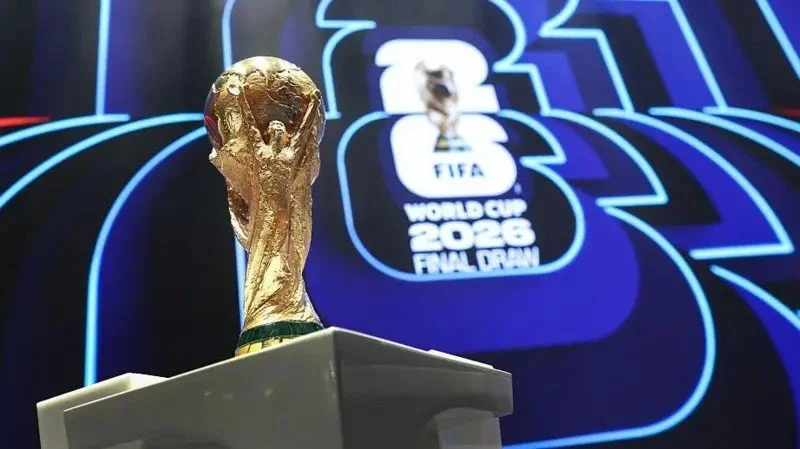
(Photo: Getty Images)
The 2026 World Cup in North America represents the peak of the modern sports industry. Massive stadiums, a record-breaking tournament: revenues are projected to reach $10.9 billion, a roughly 56 percent increase compared to the 2022 World Cup in Qatar. Some sports economists have described it as football’s North American “iPhone moment.” Just as Apple reshaped consumer technology, this tournament could redefine the business model of the game.
But as the spectacle and revenues reach new heights, a simpler question remains: what is left of the game when everything is measured, controlled and increasingly driven by data and AI?
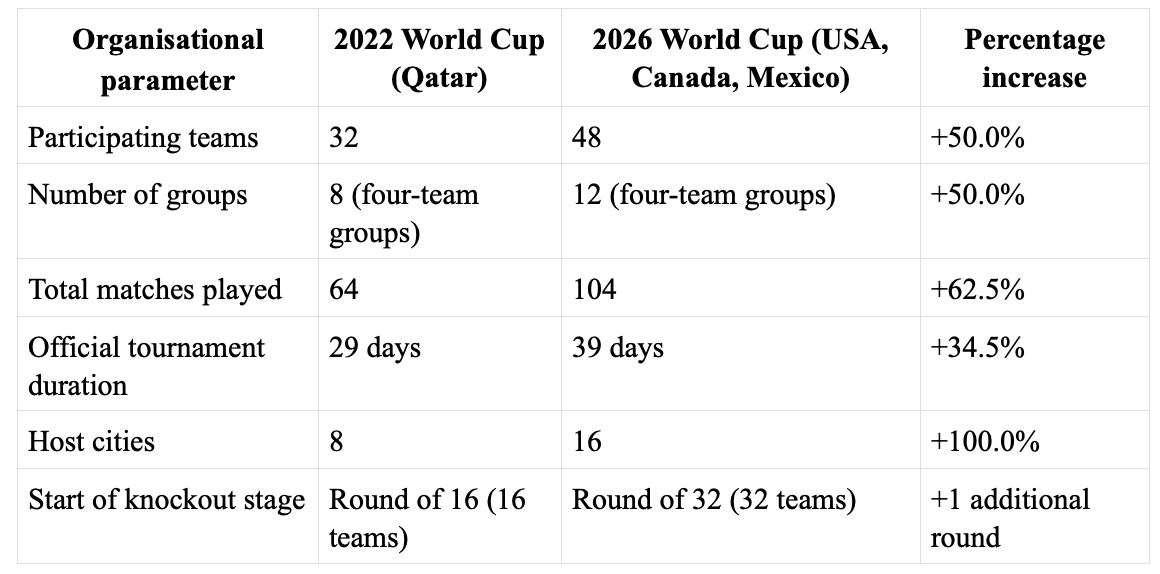
Let’s start with the elephant in the room: the 48-team format. FIFA has expanded the tournament from 32 to 48 teams, resulting in a 104-match marathon, a move many critics see as sacrificing quality for quantity and profit. The math is straightforward: from the 12 groups, not only the top two teams advance, but also the eight best third-placed sides. As a result, the risk of elimination drops significantly for a large portion of the field. The original plan was even more controversial: FIFA initially proposed three-team groups, but abandoned the idea in 2023 amid concerns over collusion, reduced competitiveness and the risk of anti-climactic final matches.
The scale of that expansion is difficult to grasp without looking at the numbers:
Just imagine the kind of football this format is likely to produce in the group stage. Teams will quickly realize that a single win, or even two disciplined, hard-fought draws, may be enough to go through. In that context, taking risks can start to look unnecessary, even reckless. Historically, progressing without a win has been extremely rare – Chile in 1998 reached the knockout stage with three draws and no victories – but under the new format even a team with two draws and a defeat could, in extreme cases, still advance.
At the 2018 FIFA World Cup, France and Denmark played out a dull, uneventful 0–0 draw that comfortably sent both teams into the knockout stage. At the same tournament, Japan spent the final 15 minutes of their match against Poland passing the ball around in their own half while trailing 1–0. They knew exactly what they were doing: thanks to the fair play rule, fewer yellow cards meant they would still advance ahead of Senegal without taking any risks.
Football has a long memory for these situations. The 1982 World Cup match between West Germany and Austria, known as the Disgrace of Gijón, has become the defining example of what happens when incentives go wrong. The 2026 format, with multiple third-placed teams advancing, risks turning such scenarios from rare exceptions into a built-in feature of the tournament. The path to the Round of 32 could easily become a cautious, low-risk exercise rather than a genuine contest.
The Logistics Problem
And if the declining quality of matches were not enough, there is also the logistical reality. At the 2022 FIFA World Cup, stadiums were often within subway or driving distance of each other. In North America, teams and supporters will have to cover distances on a continental scale. Following the draw, for example, teams in Group J are expected to travel more than 6,200 miles during the group stage alone, while those in Group I will “only” cover around 1,100 miles. For context, the journey from Vancouver to Miami is roughly 3,500 miles.
This constant, large-scale movement is not just a logistical issue. The tournament’s carbon footprint is estimated at around 9 million tons of CO₂, an environmental cost that is difficult to ignore. It also raises public health concerns. With rising temperatures, extreme heat and the physical strain of continuous travel, experts warn of an increased risk of infections, including norovirus and other gastrointestinal illnesses, among both players and supporters.
Beyond revenues and logistics, another shadow hangs over the tournament: the risk of a “fan-less” World Cup. Despite the projected financial success, stricter immigration policies in North America could limit access for international supporters. Visa processing times for the United States are already critical in several countries: close to 878 days at the embassy in Mexico City, 685 days in Bogotá, and more than 200 days even in Morocco.
Although the U.S. State Department has introduced an expedited system known as the “FIFA Pass,” the risk remains that tens of thousands of fans from South America, Africa and Asia could be left outside the borders for administrative reasons. If that happens, the stands may be filled not by traveling supporters and national fan cultures, but by wealthier local audiences and corporate guests.
Faster Game, Heavier Cost
At the same time, IFAB, football’s law-making body, is pushing in the opposite direction, launching a campaign against time-wasting and inactivity with a set of far-reaching measures. Under the new rules, substitutions must be completed within 10 seconds, throw-ins taken within 5 seconds, and goalkeepers are allowed to hold the ball for no more than 8 seconds. Exceeding this limit results in a corner for the opposition. In addition, to curb tactical stoppages, a mandatory one-minute rule has been introduced: if a player requires treatment on the pitch, they must leave the field for 60 seconds afterwards, forcing their team to temporarily play a man down.
We saw a different approach at the 2022 FIFA World Cup, where added time regularly stretched to eight or even ten minutes to compensate for stoppages. In some cases, matches effectively ran 15 minutes longer than the regulation 90 minutes. In fact, records were broken: in the England vs Iran match, a total of 27 minutes of stoppage time was added across the two halves. The question now is which path FIFA will follow. Will longer ball-in-play time reduce stoppage time, or will commercial considerations continue to push matches beyond their traditional limits?
The intention is clear and, in many ways, welcome: speed up the game and eliminate dead time. On the pitch, however, the consequences could be severe. More effective playing time means greater physical load. The gap between teams may widen further. The ball will be in play more often, but in evenly matched games the overall tempo may actually drop as fatigue sets in, while the risk of injuries increases. Elite teams from Europe and South America, conditioned by top-level club football, are likely to benefit. Smaller nations, which have traditionally relied on slowing the game down and breaking up play to stay competitive, may find that option taken away.
The question is whether the players can sustain it. According to FIFPRO, elite players such as Jude Bellingham, Vinícius Júnior and Cole Palmer are completing a third consecutive year without meaningful rest. After the 2024 continental tournaments and the expanded 2025 Club World Cup, many will arrive at the 2026 World Cup with 70 to 80 competitive matches already in their legs.
And then there is the North American summer. Extended playing time, constant intensity, transcontinental travel, all in 95-degree heat on a Florida afternoon. On top of that, the tournament schedule spans an unusually wide range of kick-off times, with matches starting in 13 different slots from as early as 12:00 local time to as late as 22:00. Even the final is scheduled for a 15:00 local kick-off, largely to accommodate global television audiences. If there is a point where the true cost of this expansion becomes visible, it will be here: in exhausted players, mounting injuries, and a noticeable drop in match quality as the tournament reaches its final stages.
Artificial Surfaces, Real Consequences
The physical strain is further compounded by another issue: the looming “turf war.” Many of the 2026 U.S. venues, including AT&T Stadium in Dallas and Mercedes-Benz Stadium, are built for the NFL and use artificial turf as standard. FIFA, however, strictly requires natural grass.
To bridge that gap, organizers have turned to a multi-million-dollar, high-risk agronomic experiment. Stadiums will install hybrid pitches made up of 90 to 95 percent natural grass reinforced with 5 to 10 percent synthetic fibers, laid and maintained using heavy rollers and GPS-guided machinery. The challenge is obvious: this grass must survive inside enclosed, climate-controlled NFL arenas with limited sunlight, while withstanding an unprecedented level of use. Once the tournament ends, most of these venues will revert to artificial turf.
This artificially sustained “Frankenstein pitch” – already criticized during the 2025 Club World Cup by Luis Enrique, who noted that the ball bounced “like a rabbit” – could further increase the risk of injury for players who are already under extreme physical stress.
And then there is another, distinctly American factor: the weather protocol. Under weather-safety protocols commonly applied at U.S. sporting events, if lightning is detected within roughly 8 to 10 miles of a stadium, play must be suspended immediately. A 30-minute countdown follows each strike, and any new lightning resets the clock. A single summer storm – a routine occurrence in cities like Miami or Houston – can delay a decisive World Cup match for hours.
Players are left sitting in the locker room, cooling down, losing both tactical focus and physical readiness, only to return to the pitch with cold muscles to finish the game. During the Club World Cup, play was suspended six times due to storms; in the Benfica vs Auckland City match alone, the delay stretched to nearly two hours. Enzo Maresca, head coach of eventual winners Chelsea, was blunt in his assessment.
“It’s already six games they’ve suspended here. I think it’s a joke. It’s not football. It’s completely amazing, something new that I struggle to understand. I get that for safety you have to suspend the game, but if you’re stopping seven or eight matches, maybe this isn’t the right place for the competition" – he told News18.com.
The Price of Precision
While players struggle against the elements, the machines see everything. Artificial intelligence systems supplied by Genius Sports and Lenovo, player bodies turned into detailed 3D avatars, millisecond tracking of the slightest touch, and body cameras mounted on referees all create the illusion that football is becoming fairer.
But perfect accuracy comes at a cost. When a goal is ruled out by the system with centimeter-level, almost forensic precision – not because the attacker gained a real advantage, but because his shoulder extends a fraction offside – something essential is lost. The more the game is reduced to data points and margins, the more it risks stripping away the unpredictability and human element that made people fall in love with it in the first place.
The show must go on. The 2026 World Cup will undoubtedly be a peak moment for the entertainment industry: a fast, spectacular, highly engineered event, driven by data and billions of dollars. With stricter rules, dead time will shrink, the tempo will rise, and fans, through augmented reality and second-screen experiences, may feel as if they are interacting with a vast, real-time simulation.
But after a month of relentless, data-driven football, of machine-assisted decisions, hybrid pitches and exhausted players, one question will remain: is this still good for the game?
