Those Left Behind: The Biggest Absentees from the 2026 World Cup
Written by Balázs B. Tóth May 03, 2026
Every World Cup has its absentees, and the 2026 tournament will be no exception. Despite the expanded field, several world-class players will miss out on football’s biggest stage. Here are the biggest stars set to miss the largest World Cup in history.
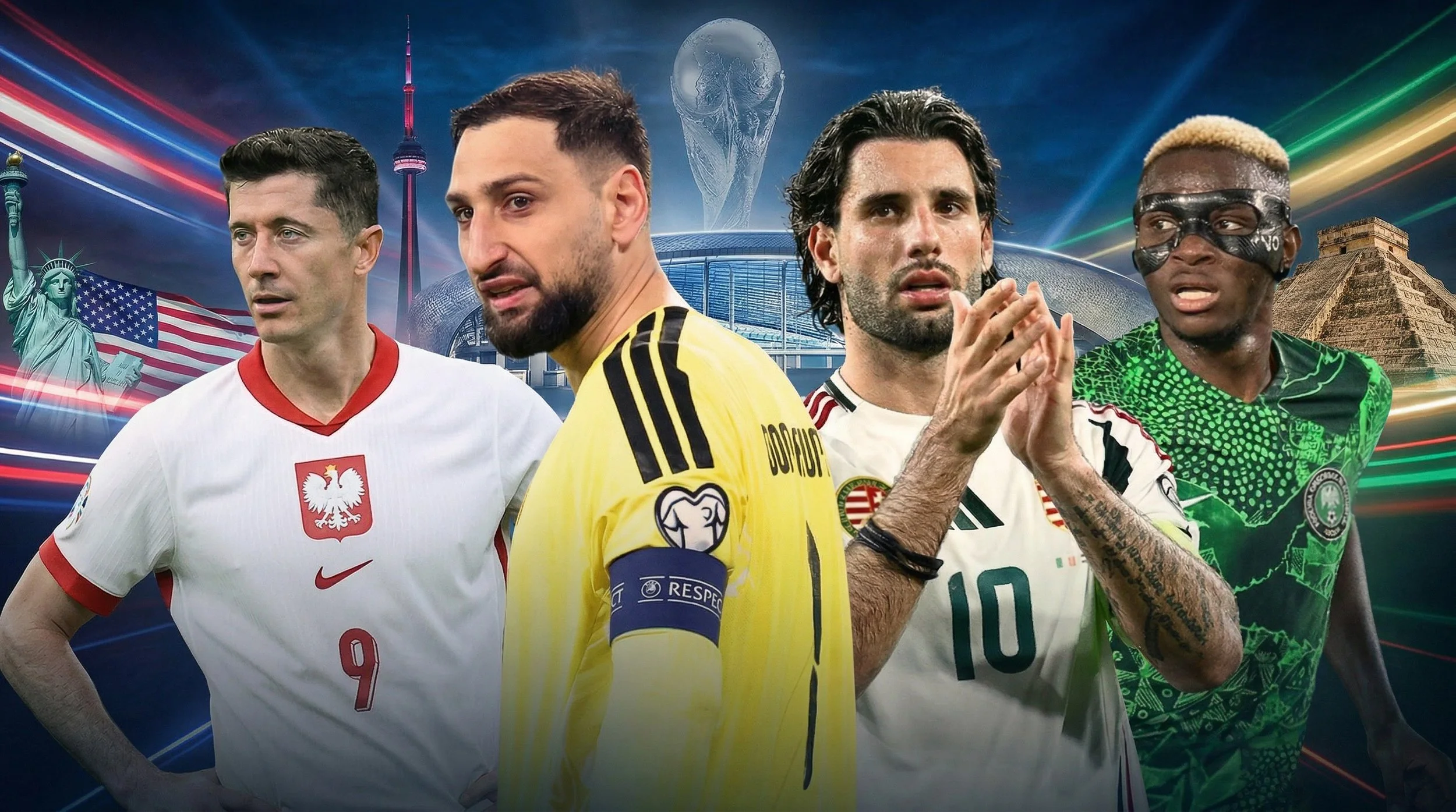
(Photo: Created by AI)
Every World Cup begins with what we do not see: the list of those left behind. Qualifying strips away every romantic narrative, reminding us of one of football’s most unforgiving truths — the most talented players do not always make it, only those backed by the right team.
The phenomenon is nothing new. Football history is filled with greats who never played at a World Cup. Ryan Giggs, Eric Cantona, George Weah and Alfredo Di Stéfano all serve as reminders that World Cup participation is not the sole measure of greatness.
And yet, something always feels missing when the defining players of an era are absent from the game’s biggest stage.
Robert Lewandowski — Poland
Age: 37 | Club: FC Barcelona | Caps: 165 | International goals: 89 | Previous World Cups: 2018, 2022
After the final whistle, Lewandowski posted a single photo to Instagram. Just him, holding the captain's armband, with Andrea Bocelli's "Time to Say Goodbye" playing beneath it. No caption. No explanation. Everyone understood.
Embed it: https://www.instagram.com/p/DWkF56SDOOL/?utm_source=ig_web_copy_link&igsh=NTc4MTIwNjQ2YQ==
Poland had equalized twice against Sweden in the playoff final before Viktor Gyökeres struck in the 88th minute to settle it. Lewandowski – the most capped and highest-scoring player in Polish football history – stood at the center of the pitch, 37 years old, watching the Swedes celebrate around him. He knew it was over.
The numbers that define his career barely capture what he meant. Two FIFA Best awards. A Champions League title. 41 Bundesliga goals in the 2020–21 season, erasing Gerd Müller's record that had stood for nearly half a century. More than 600 career goals. His 89 international goals are almost double what any other player has ever scored for Poland. His World Cup record, by contrast, tells a different story: two tournaments, seven matches, two goals – both scored in Qatar in 2022, when Poland reached the knockout stage before losing to France. The country simply never built a team worthy of him.
His final season in Barcelona has only underlined the arc. He has started fewer than half of Barcelona’s league games this season, a long way from the player who once seemed immune to decline. His contract expires in the summer, and he does not yet know what comes next. He has asked for time until the end of April.
By the time the next World Cup arrives, he will be 41. The chances of seeing him on that stage again are effectively zero. The Bocelli song was not just for the national team.
Gianluigi Donnarumma — Italy
Age: 27 | Club: Manchester City | Caps: 81 | World Cups: 0
After Italy’s latest collapse, there were plenty of names to choose from. Players who should have been on football’s biggest stage, but never made it. Still, Gianluigi Donnarumma stands out.
At the end of the Euro 2020 final, he fell to the turf and cried. Italy had just won the tournament. He was named player of the tournament, the first goalkeeper in history to receive the award. He was 22. It felt like the world was opening in front of him.
Five years later, in the playoff final against Bosnia, Alessandro Bastoni was sent off in the 43rd minute. Italy played the rest of the match, and extra time, with ten men. Then came the penalty shootout. They lost it 4–1. Donnarumma stood in goal. It was not his fault. He made 10 saves.
It was the third consecutive World Cup Italy had failed to qualify for. Donnarumma had been part of the squad every time. The darker irony is this: in the current national team, rebuilt in recent months under Gennaro Gattuso, there is not a single player who has ever appeared at a World Cup.
What Donnarumma has done at club level would be enough for most careers. Two Yashin Trophies as the world’s best goalkeeper. A Champions League title with Paris Saint-Germain in 2025.
He is 27, already one of the defining goalkeepers of his era. And yet, he has not played a single minute at a World Cup. When he made his debut in 2016, he was 17, the youngest player ever to represent Italy. The last time Italy played a World Cup match, in the group stage in 2014, he was just 15. If Italy finally breaks the cycle and qualifies in 2030, Donnarumma will be 31 by the time he steps onto a World Cup pitch for the first time. The prime of his career is passing without the game’s biggest stage. And the hardest part is this: none of it is his fault.
Khvicha Kvaratskhelia — Georgia
Age: 25 | Club: Paris Saint-Germain | Caps: 49 | International goals: 22 | World Cups: 0
Khvicha Kvaratskhelia completed a €70 million move to Paris Saint-Germain in January 2025. By the end of the season, he was a Champions League winner. He scored in the final. Since then, the list has only grown longer. Ligue 1 champion. Domestic cup winner. UEFA Super Cup. FIFA Club World Cup. At 25, he has already won almost everything a footballer can dream of. Almost.
He has never played at a World Cup.
Georgia is a country of just 3.7 million people. At Euro 2024, they made history by qualifying for a major tournament for the first time. Then they went further. A win over Portugal became one of the most memorable upsets in recent European football. Kvaratskhelia was at the center of it all.
World Cup qualifying brought a harsher reality. Drawn against Spain and Turkey, Georgia managed one win and five defeats from six matches. The gap, at least for now, remains. And yet, there is reason to believe. Georgia already has the outline of a top-level core. Kvaratskhelia leads the attack. Georges Mikautadze provides goals. Giorgi Mamardashvili anchors the team in goal.
All three are 25. By the time the 2030 World Cup arrives, they should be entering their prime together. For a country like Georgia, that kind of alignment does not come often.
The opportunity may not come many times. But it is there.
Victor Osimhen — Nigeria
Age: 27 | Club: Galatasaray | Caps: 52 | International goals: 35 | World Cups: 0
The most expensive African footballer of all time, a €75 million signing for Napoli and a continental record. African Player of the Year in 2023. A former Serie A top scorer. With 35 international goals, he is already Nigeria’s second-highest scorer of all time, within reach of Rashidi Yekini’s record of 37. It might already be gone if Osimhen had ever played at a World Cup.
His absence from the tournament has begun to feel almost inevitable. In 2018, when Nigeria qualified, he was too young and too raw to make the final squad. By 2022, he had become the face of the team, yet Nigeria still failed to qualify in dramatic fashion.
The 2026 campaign brought the most painful blow. The decisive playoff against DR Congo ended 1–1 and went to penalties, where Nigeria lost 4–3. Osimhen was not even on the pitch by then, forced off at halftime through injury, watching helplessly from the touchline, in tears, as the shootout unfolded.
That is the cruelest part of the story.
The failure is even harder to explain when you look at the squad. Nigeria had quality across the pitch, with Osimhen supported by players such as Ademola Lookman, the reigning African Player of the Year and the hero of a Europa League final hat-trick. On paper, it was a team that should have been at the World Cup, yet African qualifying rarely follows the logic of reputation.
By the time the 2030 World Cup arrives, Osimhen will be 31. There is still time to change the narrative, but for now, one of the best strikers of his generation remains absent from the biggest stage of all.
Szoboszlai Dominik — Hungary
Age: 25 | Club: Liverpool FC | Caps: 63 | International goals: 17 | World Cups: 0
Hungary have not played at a World Cup since 1986. Forty years. Not a single player in the current squad was alive the last time the national team appeared on that stage. Even the oldest member of the squad, goalkeeper Péter Szappanos, was born in 1990.
Until the final moments of the 2026 qualifying campaign, it felt like that run might finally end. Hungary were still in contention, and in a sold-out Puskás Aréna, a draw against Ireland would have been enough to reach the playoffs. They were leading in the 80th minute.
Then Troy Parrott changed everything.
He scored in the 80th minute, and again in the 96th, completing a dramatic hat-trick that ended Hungary’s hopes. Szoboszlai was left on the pitch at full time, in tears. Later, he posted a message on Instagram: “It hurts. It hurts because we really wanted it. Not just for ourselves, but for you as well. […] We owe you, and ourselves, a World Cup.”
The contrast with his club form could hardly be sharper. While Liverpool have struggled this season, Szoboszlai has carried the team at times, delivering elite performances in midfield and even filling in at right-back when needed. According to Transfermarkt, his market value stands at €100 million, making him the highest-valued player among those absent from the World Cup.
He is also closing in on a remarkable milestone. Four direct free-kick goals in a single Premier League season have already set a Liverpool club record. Two more would see him surpass the long-standing league mark set by David Beckham and Laurent Robert in 2001.
By the time the 2030 World Cup arrives, Szoboszlai will be 29, right in the middle of his prime. Unlike others on this list, time is still on his side. He is not alone either. Players such as Milos Kerkez, already establishing himself in the Premier League at 22, point to a generation that may yet take Hungary back to the biggest stage.
Alexis Sánchez — Chile
Age: 37 | Club: Sevilla FC | Caps: 168 | International goals: 51 | Previous World Cups: 2010, 2014
After Chile’s dismal qualifying campaign came to an end, Sánchez kept it simple. “The golden generation is buried. I am the last one left,” he told ESPN.
Chile finished bottom of the CONMEBOL standings, in tenth place. Two wins from 18 matches. Nine goals scored, 27 conceded. The numbers alone are damning. The context makes them worse. With the expanded World Cup, South America now had six automatic qualification spots. Chile still fell to the very bottom.
And yet Sánchez is the same player who led his country to the summit of South American football. Back-to-back Copa América titles in 2015 and 2016, both sealed in penalty shootouts. A career that took him through some of Europe’s biggest clubs, including Barcelona, Arsenal and Inter.
He is Chile’s record appearance-maker and one of its greatest goalscorers. Alongside Arturo Vidal, Claudio Bravo and Gary Medel, he was the face of a generation that reached the round of 16 at both the 2010 and 2014 World Cups, losing to Brazil each time.
At the 2030 World Cup, Sánchez will be 41. Like Robert Lewandowski, his chapter with the national team is effectively over. The difference is this: Chile’s golden generation never truly had its defining World Cup run, even at its peak.
Bryan Mbeumo — Cameroon
Age: 25 | Club: Manchester United | Caps: 32 | International goals: 7 | World Cups: 2022
One of the standout performers of the 2024–25 Premier League season was Cameroonian. Bryan Mbeumo’s outstanding campaign at Brentford earned him a move to Manchester United, taking him to Old Trafford in the summer. At 25, he has firmly established himself among the league’s top wingers.
He has already experienced the game’s biggest stage, making an appearance at the 2022 World Cup in Qatar. The next chapter will have to wait. While his club career has reached new heights, his journey with the national team has taken a very different turn.
Cameroon are Africa’s most frequent World Cup participants, having qualified eight times. In 2026, they will not be there. The decline began in the group stage of qualifying, where they finished behind Cape Verde, a nation preparing for its first World Cup appearance.
The final blow came in the playoff semi-final. DR Congo eliminated them with a 91st-minute winner from Chancel Mbemba. The same DR Congo side would later end Nigeria’s hopes as well, sealing the fate of Victor Osimhen and returning to the World Cup for the first time since 1974.
While Mbeumo was shining week after week in one of the world’s strongest leagues, everything around the national team was falling apart. The failure was not only about performances on the pitch. A damaging power struggle emerged within the federation, between president Samuel Eto'o and the sports ministry. Coaches came and went, cohesion disappeared, and the instability gradually consumed the team’s chances.
By the time the 2030 World Cup arrives, Mbeumo will be 29, right at the peak of his career. If Cameroon can restore stability off the pitch, he could become the central figure of a new generation. The record of eight World Cup appearances will remain a source of pride. For now, though, it will not be extended.
Some will miss out through injury
Although the official squads have yet to be announced, the list of absentees will include more than just those who failed to qualify. Injuries will keep several high-profile players away from the tournament.
Rodrygo is certain to miss out after suffering a knee ligament injury in the spring, while England internationals James Maddison and Levi Colwill have both seen their World Cup hopes ended by ACL injuries. For Germany, Marc-André ter Stegen’s long-term injury has already settled the issue.
Spain could also be without Nico Williams and Mikel Merino, both recovering from leg surgeries, while Brazil face uncertainty over Neymar, whose recurring physical problems remain a concern.
The situation of Alexander Isak is also unclear. Sweden have qualified, but the striker is dealing with injury, and his place in the squad may not be decided until the final weeks.
At the same time, the tournament quickly makes room for new names. Erling Haaland is set to play at a World Cup for the first time at 25, after Norway finished ahead of Italy in qualifying. Lamine Yamal, Florian Wirtz and Viktor Gyökeres are also preparing for their first appearances on the global stage, while Lionel Messi and Cristiano Ronaldo are almost certain to be playing at the final World Cups of their careers.
